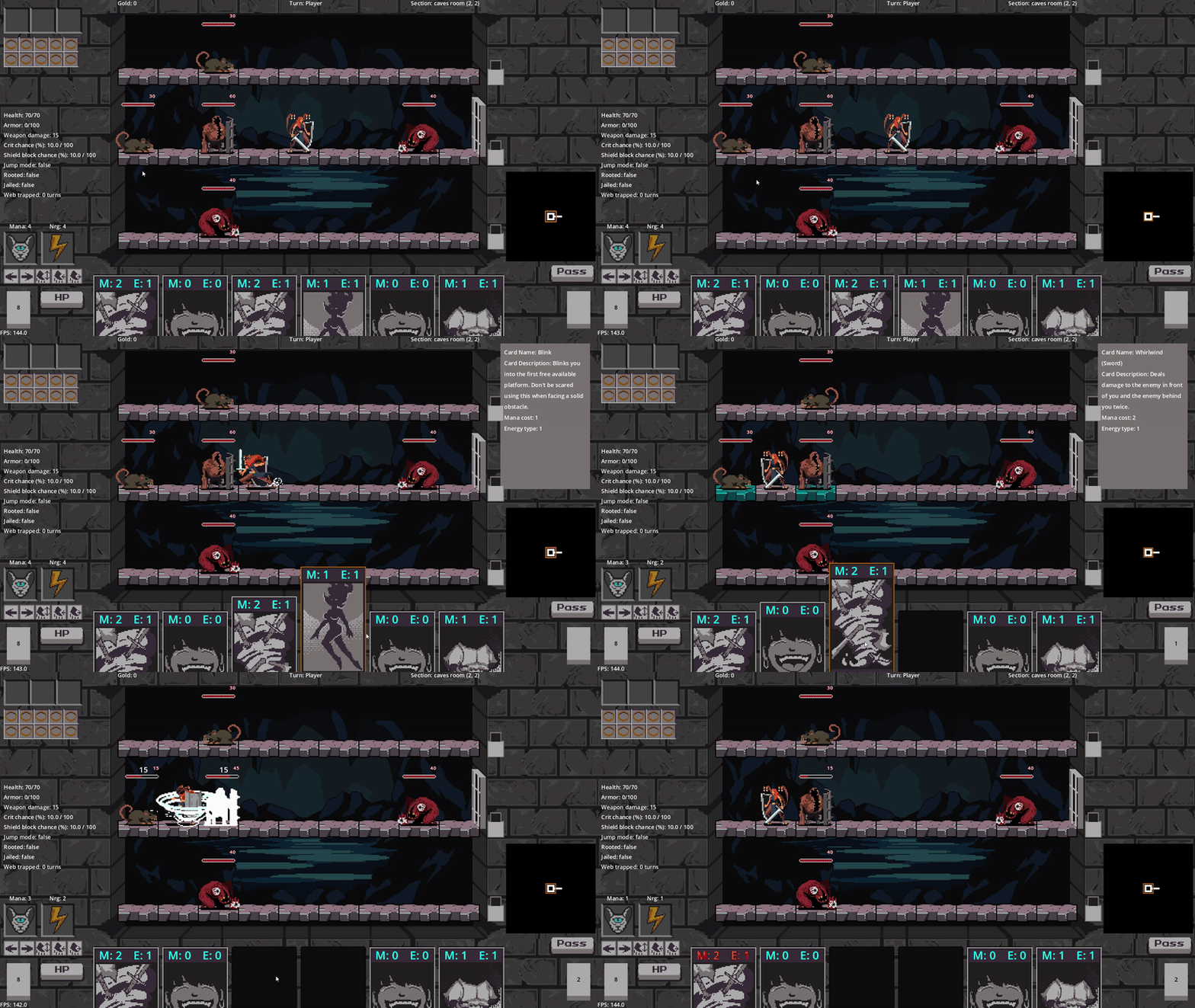
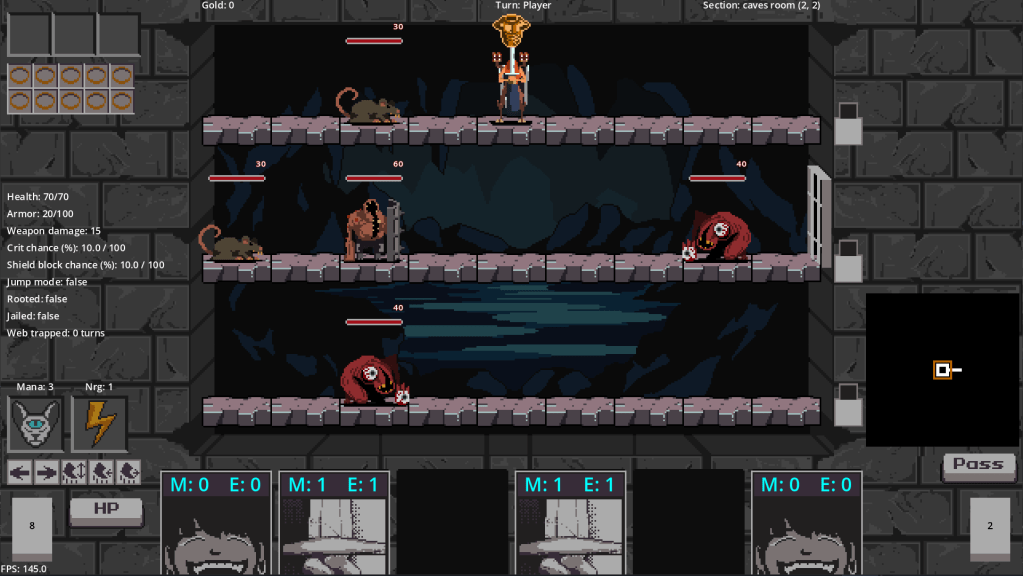
I have been in the software development industry for almost 15 years now and I can safely say that, at least for me, game development has been the most fun and stimulating kind of work. It constantly throws new challenges at you and solving them can be both painful and deeply rewarding. The excitement when things finally come together is unmatched.
That said, many people tend to think game dev is all about gameplay programming, with flashy mechanics, combat systems, cards, and visual effects. But over time I have learned that is not really the full picture, and Gotogra reminded me of that again and again.
Building Tools: The Dungeon Editor
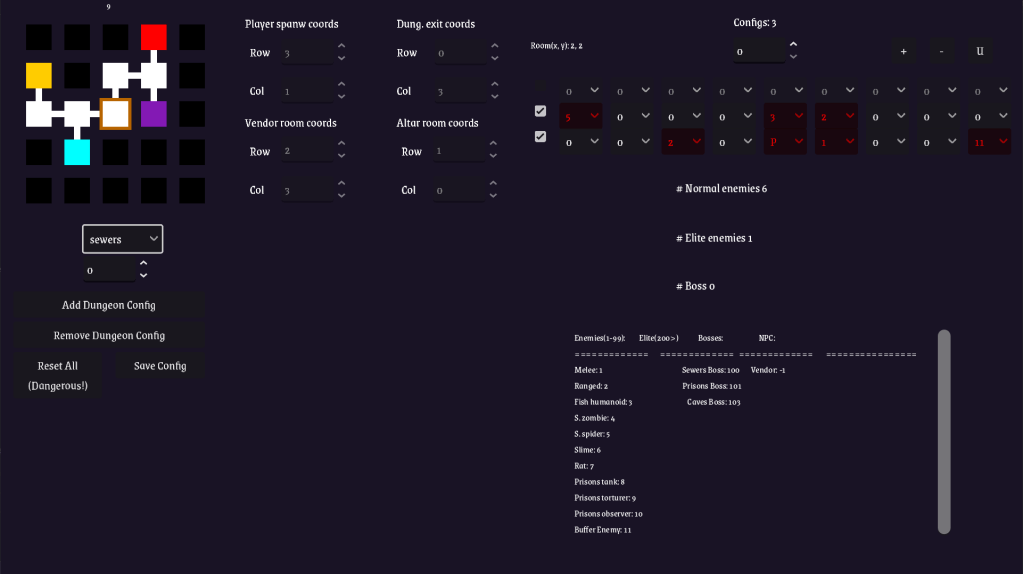
One of the biggest time investments early on was a custom tool for editing and generating dungeons. Gotogra uses a randomized approach for dungeon generation, but it is based on a manually designed pool of encounters. This lets me control how rooms appear while keeping every run unpredictable but fair.
To make that work, I had to create a special in-house editor. It is nothing too fancy, but it took about a month of full-time work to reach a functional version. I still maintain and tweak it regularly. It is not gameplay, but it is one of those tools that quietly saves me a huge amount of time and helps the game stay consistent.
The Save System: A Month of Invisible Work
Another feature that does not look exciting but is absolutely necessary is the save system. This one also took around a month of dedicated development. It allows players to quit the game at any time during a run and return exactly where they left off with cards, dungeons, enemies, and everything else preserved.
Under the hood, the solution is simple. I serialize the game state to disk and then rehydrate all objects on load. It is the kind of system that nobody notices when it works, and that is exactly how it should be.
Closing Thoughts
Both of these systems, the dungeon configuration tool and the save system, are not the most exciting things to show in a devlog, but they are crucial. They represent the less visible side of game development, the infrastructure that makes the fun stuff possible.
And honestly, I still find them fun in their own way. They are little engineering puzzles that make Gotogra more stable, flexible, and enjoyable for everyone.
The next updates will focus more on gameplay features, which are definitely easier and more exciting to show publicly. But I thought it was worth sharing this small behind-the-scenes look at what has been going on lately.
Thanks for reading, and as always, thank you for following Gotogra’s journey.
We’ve been really hard at work since our last playtest. There were some key areas we needed to touch and improve. The way movement worked for the player had some unnecessary friction on a core foundation of the game. This needed our full focus for improvements. We also worked on the removal of lane buffs, the effect of the doom counter when it expires, a brand new weapon, and finally the game’s tutorial. Having a tutorial in place is especially important to us as it sets the stage for smoother future playtesting.
1. Movement: Changed for Good
During our first playtests, players felt some frustration with how movement worked. We had two systems. Jumping and linear movement. The cost structure didn’t really make sense. Jumping was almost always better, since for just 2 energy you could move up to three platforms at once. That made single tile moves inefficient. Players were forced into a clunky two step process for something that should have been simple and core to Gotogra.
So we decided to completely rework movement. In the new version, linear movement always costs just 1 energy and can be done with a single click on the target tile. Available tiles are highlighted in green. The only time movement costs 2 energy is when you jump over an enemy. Even then, you just click your destination tile and the game automatically handles whether it’s a simple move or a jump over an obstacle.
This change removes friction. It makes movement more intuitive and reinforces it as one of the game’s core mechanics.
2. Farewell to Lane Buffs
During playtests, lane buffs were mostly ignored. When they did trigger, many felt too mild since they only impacted the lane where they appeared. Others were too strong, and that created frustration. The main problem was that lane buffs were abstract elements of gameplay. Players had no real agency over them.
For this reason we removed lane buffs and introduced caster enemies. They work like normal enemies with a preparation turn before casting. After that they cast one of the same effects that lane buffs used to create, but now in the form of spells. Spells are selected at random. A crucial difference is that these spells affect everyone on the field, both enemies and the player, no matter what lane they are on.
This makes the effects feel fairer and more interactive. It also creates new tactical challenges since you can deal with caster enemies directly.
3. The Doom Counter Reworked
In the old system, when the doom counter reached zero the player died instantly. This felt really bad. It made the player’s remaining HP useless. Dying suddenly no matter how much health you still had was never pleasant.
Now the system works differently. When the doom counter reaches zero the player starts taking fatigue damage. This damage ramps up each turn. It allows the player to still finish clearing the room, but they cannot waste too many turns. The longer they stay, the faster their HP will go down. Fatigue damage is pure damage and goes through armor.
4. A New Weapon: The Bow
When you meet the vendor for the first time you will now see a new choice. Along with the sword and shield you can also pick the Bow. This is a fresh new experience for Gotogra. The bow is a ranged weapon and it makes the player manage an extra resource. A quiver with three arrows.
When you use cards called “shot” they consume an arrow on top of their mana or energy cost. At first this might look weaker compared to the simple sword and shield. But arrows are regenerated at the start of the player’s turn, just like mana and energy. On top of that there are many ways to reload the quiver with cards or rings.
The most important part is that each arrow can be enchanted with different effects. These enchantments combine with shot cards in fun ways. For example there is an enchantment that makes your next shot a guaranteed critical strike. Imagine using this with a shot called Drill Shot. This card pierces through a line of enemies. If there are three enemies in a row and you fire a critical Drill Shot, all three take guaranteed critical damage.
This is just scratching the surface. The bow has many possible synergies left for the player to discover. We will not spoil more here since a dedicated devlog will be made for the bow in the future.
5. First Tutorial Implemented
A first version of the tutorial is now in the game. It introduces players to the basic mechanics of Gotogra. The design is simple on purpose. We do not want to fully hand hold players. We believe our audience enjoys the process of learning new skills. The tutorial gives enough guidance without taking away that joy and magic.
The biggest benefit for us is practical. From now on it is easier to hand Gotogra to new testers. In most cases we can simply send them a build and rely on the tutorial to do the first teaching. This saves us from having to always set up virtual calls. It is a real step forward.
The tutorial will need improvements, but now it is there and this is an important milestone.
Outro
These updates mark a huge milestone for Gotogra. Movement is now set in stone. Lane buffs have evolved into more engaging enemy abilities. The doom counter has been reworked for fairness. A new weapon joins the arsenal. The first tutorial is in place. Together, these changes make the game more strategic, accessible, and fun to play.
In the next blog post, planned for the first days of September, we will share an important update. We will be applying to some local financing opportunities. The outcome is uncertain, as there are many talented developers with the same needs, but it is an opportunity worth pursuing. More details about this coming soon.
As always, thank you for following along. Your feedback shapes Gotogra every step of the way.
After a month of intense development, we finally conducted Gotogra’s first closed playtest with a small group of fresh players. First off, apologies for the lack of new devlogs—preparing this build took our full attention. The playtest group was around ten people from our personal circle, ranging from avid gamers to folks who rarely play games. This mix was intentional: we wanted to see how easily even non-gamers could pick up Gotogra’s basics, and how seasoned players would engage with its deeper systems.
asnowgoose and SORRYCAT
Overall, the session was incredibly insightful. Below, we break down what clicked, what caused confusion, and how we plan to refine the game moving forward.
Core Mechanics & Learning Curve
One encouraging result was that almost every tester quickly grasped Gotogra’s core mechanics. They understood how to move the character on the platforms and how to spend resources to move or play cards without much trouble. This suggests our tutorials and UI for basic actions are on the right track, making the game accessible even to those with limited gaming experience.
However, we did notice a common stumbling block: understanding enemy behaviors and abilities. Several testers weren’t sure what each enemy type did at first glance. Our current tooltips or visual cues for enemy intent might not be clear enough for newcomers. We plan to polish this aspect with cleaner explanations or visual indicators so players can better anticipate what an enemy will do.
That said, it’s not necessarily a bad thing if everything isn’t understood immediately. Gotogra is a roguelike, and part of the fun in roguelike games comes from discovery and learning through failure. It’s okay (and often rewarding) for players to be challenged on their first run, fail, then come back armed with new knowledge. Iterating through runs and gradually uncovering what enemies do can provide that satisfying “aha!” moment and a dopamine boost when you finally overcome a challenge. Our goal is to find the right balance—make enemy intents clearer without completely hand-holding the player or spoiling the surprise of learning through experience.
User Experience: Balancing Clarity and Friction
In terms of user experience (UX), we received one notable piece of critical feedback. A tester identified a couple of pain points in how players interact with cards and the game board:
Accidental Card Plays: Right now, playing a card is as simple as clicking it. One tester found this too easy to mis-trigger; a quick accidental click could play a card they didn’t intend to use, potentially wasting a resource or cooldown. They suggested adding a confirmation step (like “Are you sure?” or a drag-and-drop mechanism) to prevent unintended card plays.
Facing Direction & Targeting: Gotogra’s card effects depend on the direction your character is facing (since many attacks or skills target platforms in front of you). This tester sometimes lost track of the hero’s facing and played a card, only to have it affect the wrong direction or miss the intended target. The feedback was that the game could do more to remind or show players which way their character is oriented before they commit to an action.
Pay attention at your position when you use a card!
Both of these issues boil down to clarity in the UI and minimizing frustration. We’ve already implemented a system that highlights the affected platforms when you hover over a card, giving a preview of where an action will land. Clearly, this indicator might not be prominent enough. To address the directionality issue, we’re considering ways to better emphasize the hero’s facing—perhaps an arrow icon on the base of the character or more pronounced highlights on the enemies that would be impacted by the card effect. We want players to think tactically, but we don’t want the interface to trick them into mistakes that feel unfair.
The idea of a confirmation dialog for card plays, however, led to a lot of internal debate. On one hand, a safety check could prevent misclicks. On the other, it introduces what we call “bad friction”—an extra step that slows the game’s pace and potentially annoys the player. Gotogra’s combat is meant to be snappy and tactical; repeatedly confirming every card use could make it feel sluggish. We ultimately lean towards avoiding a confirm button for each action, and instead focus on improving visual feedback so that players rarely misclick in the first place. Good game design is about finding the fun kind of friction (the kind that makes you strategize) and eliminating the unwarranted friction (the kind that makes the controls cumbersome).
It’s worth noting that none of the other testers reported the above issues. Most found the click-to-play system intuitive and fast, which is exactly the experience we intended. This highlights how subjective UX can be—what bothers one player might not faze another. Still, the feedback is valuable. Our plan is to enhance clarity (through better highlights, indicators, or maybe an option in settings for those who want confirmations) rather than immediately add universal confirmation prompts. We believe this approach will keep Gotogra feeling smooth and responsive while addressing the potential for error.
Early Mastery & Emergent Strategies
Interestingly, a couple of playtesters demonstrated exceptional skill right off the bat. Despite never having played Gotogra before, they picked up its nuances almost immediately and even started exploiting advanced tactics. For example, one tester quickly grasped an important deckbuilding strategy: he realized that keeping his deck lean (by skipping some card rewards) led to drawing his most powerful cards more often. In essence, he figured out the optimal number of cards for efficient deck cycling and was intentionally skipping new cards to maintain that flow.
Seeing this kind of emergent strategy was thrilling for us. It shows that Gotogra’s mechanics have a depth that savvy players can engage with. A core design goal for us is to reward knowledge and strategy—if you understand the system well, you can make clever decisions to get an edge. The fact that a first-time player discovered a pro strategy (deck size management) on his own is a positive signal that our game systems are intuitive enough to learn, yet deep enough to master.
Of course, this also gives us food for thought on tuning difficulty. If some players can optimize and breeze through early content, we need to ensure the game’s challenge scales up to match them in later levels. Roguelikes thrive on being accessible to play but difficult to win. We’ll keep an eye on how deck size strategies and other tactics affect game balance as more people play, and adjust enemy scaling or card offerings if needed to maintain a satisfying challenge for both newcomers and experts.
Audio and SFX Impressions
Another highlight from the playtest was the audio feedback. Testers overwhelmingly praised the music and sound effects in Gotogra. The background music was described as “engaging, but never annoying,” which is exactly what we hoped for in a game meant to be replayed many times. You want a soundtrack that can pump you up and immerse you in the atmosphere without grating on you after the hundredth loop. It sounds like we’re on the right track there.
Our sound effects, though currently limited in number, also received positive remarks. Players found them punchy and satisfying, enhancing the impact of actions. Even small audio cues (like the swoosh of a card or the thud of a successful hit) contribute a lot to the tactile feel of the game. We’re glad that the early audio design is resonating well, and we’ll continue to invest in sound design as development progresses. After all, in a tactical game, clarity isn’t just visual—audio cues help players understand what’s happening, and feeling the power of an ability through sound can make it that much more rewarding.
Bugs, Glitches & Ongoing Fixes
No playtest would be complete without uncovering some bugs and glitches, and our session was no exception. Testers ran into a few issues, ranging from cards not working exactly as intended to odd behavior in edge-case scenarios. In one run, for instance, a combination of status effects on an enemy caused a bizarre sequence of events that we hadn’t seen before (and definitely didn’t intend!). These situations, while a bit embarrassing in the moment, are incredibly useful to witness. Every bug is an opportunity to improve the game’s robustness.
During the playtest, we came prepared with a cheat/debug system to smooth over any game-breaking issues. This toolkit let us do things like reset a level, fix a character’s state, or even manually remove a troublesome enemy, all on the fly. It proved invaluable—when a bug threatened to halt progress, we used cheats to keep the session going so the testers could experience as much content as possible. It’s a reminder that when testing an in-development game, a little behind-the-scenes wizardry can keep the feedback flowing.
Following the playtest, we’ve been hard at work fixing the reported bugs. Our priority is to resolve the critical gameplay issues first (like cards not triggering correctly), then polish the smaller glitches. It’s an ongoing effort, but we’re knocking out bugs one by one. The game is much more stable now than it was before the test, and that’s thanks to the problems our playtesters helped us identify.
Preparing for the Demo Release
All in all, we’re very happy with how this first playtest went. It’s reassuring to see that the core gameplay is fun and comprehensible, and the feedback has shown us exactly where to focus our improvements. The playtest struck a nice balance: it highlighted some strengths to build on (accessible mechanics, strategic depth, strong audio) and pointed out the weak spots we need to address (enemy clarity, certain UX quirks, and of course, bugs).
Our next big milestone is to package a public demo build. Now that we’ve incorporated a lot of the initial feedback, we’re aiming to release a demo on itch.io in the near future. This will let a broader audience try out Gotogra and will surely bring in a new wave of impressions and data for us to chew on. If all goes well on itch.io, the plan is to follow up with a Steam demo as well, reaching even more players.
Stay tuned for news on the demo’s release date. We’re incredibly excited (and a bit nervous!) to get Gotogra into more hands soon. In the meantime, we’ll continue refining the game, adding a bit more polish with every iteration.
Thanks for reading and following along with our development journey. Your interest and support mean a lot to us. We hope you enjoyed this behind-the-scenes look at our playtest process and findings. Until next time, happy gaming—and we can’t wait to share more updates with you as Gotogra evolves!
When I decided to make Gotogra a lane-based game, I knew the lanes had to matter. I didn’t want the three-lane setup to just be cosmetic or spatial flavor — I wanted each lane to carry meaning and potential.
That’s where lane buffs came in: they give the battlefield tactical identity, and they give enemies a flexible way to scale alongside the player’s growing power. Much like Marvel Snap or early versions of Gwent, I wanted each space to feel like it had its own tension — whether it’s a benefit to stand still or a trap waiting to happen.
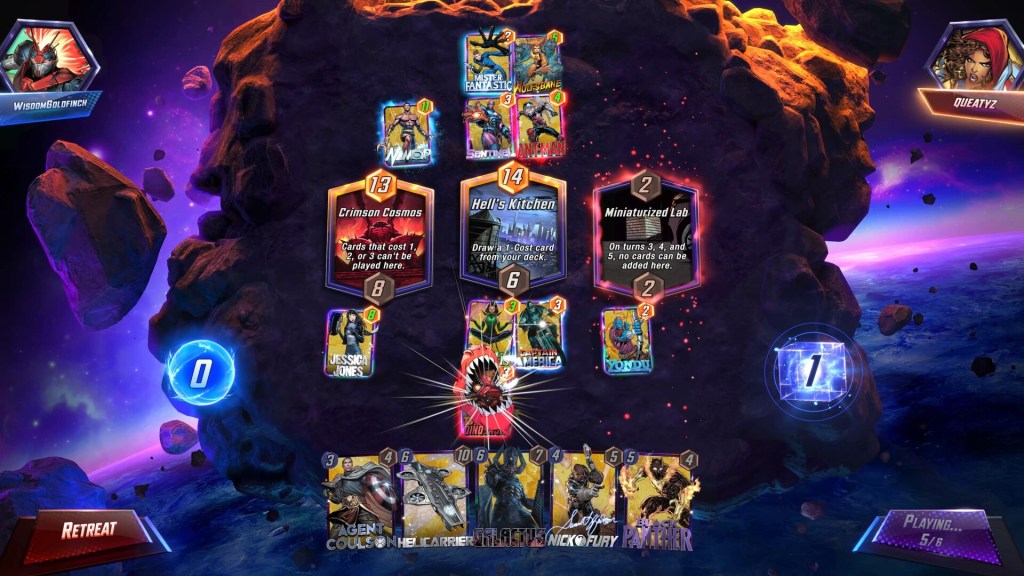
Two games that really demonstrate the power of lane-based systems are Marvel Snap and Gwent. In Marvel Snap, each lane has a randomly assigned rule that reshapes your strategy every match. Players have to adapt constantly, deciding where to commit their limited turns and cards in the face of shifting lane conditions. Keith Burgun wrote a great breakdown of this in his article: Marvel Snap is a Testament to the Power of Ruleset Design.
Screenshot from Marvel Snap
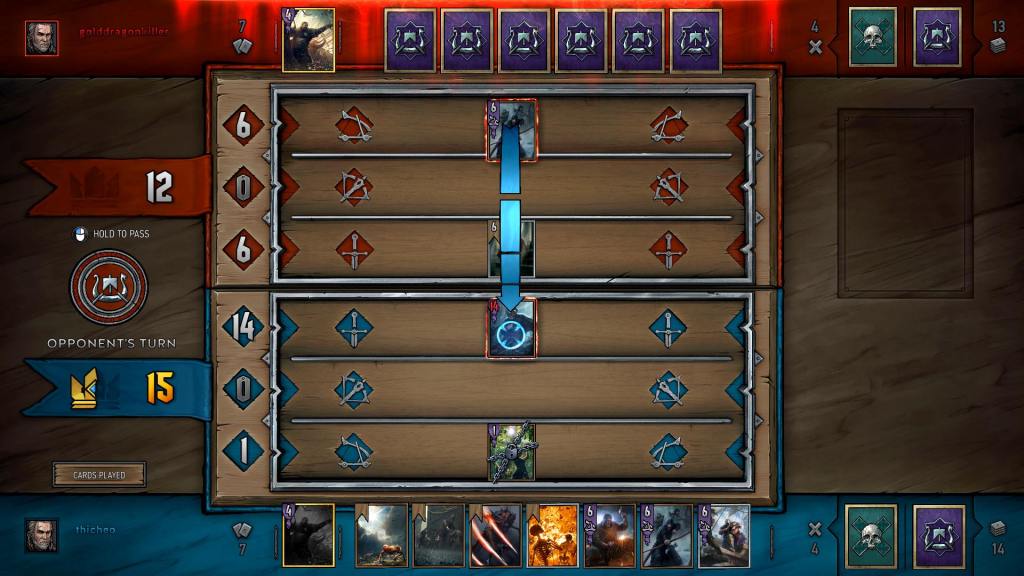
Gwent, particularly in its earlier iterations, used two distinct lanes — melee and ranged — which limited card placement and introduced environmental effects like weather that applied lane-wide. This forced players to weigh positioning, spreading their units, or risking clustered vulnerabilities. There’s a great overview of these mechanics and lessons learned in this article from Nerdlab: Gwent: 5 Exceptional Design Choices.
Screenshot from Gwent
These games helped reinforce an idea I kept coming back to during Gotogra’s design: if you’re going to divide a battlefield into lanes, each one should matter — strategically, emotionally, and mechanically.
Before going deeper into Gotogra’s lane buffs, I want to clarify something that could cause confusion: although Gotogra has a lane-based system, it’s not a traditional grid-based tactics game. At most, there are three vertical lanes, but each one is designed to carry strategic weight and provide distinct interaction opportunities.
The player’s character can jump between platforms within the same lane by spending 2 energy. Movement within a lane is flexible: the player can leap up to 6 platforms forward or backward, as long as the target platform is unoccupied. However, changing lanes is more constrained — you can only move to the directly adjacent lane (up or down from your current platform), and it still costs 2 energy.
This movement system means that even with only three lanes, positioning and decision-making are far from trivial. The rules are simple, but the implications — especially when lane buffs and enemy behaviors come into play — are rich and layered.
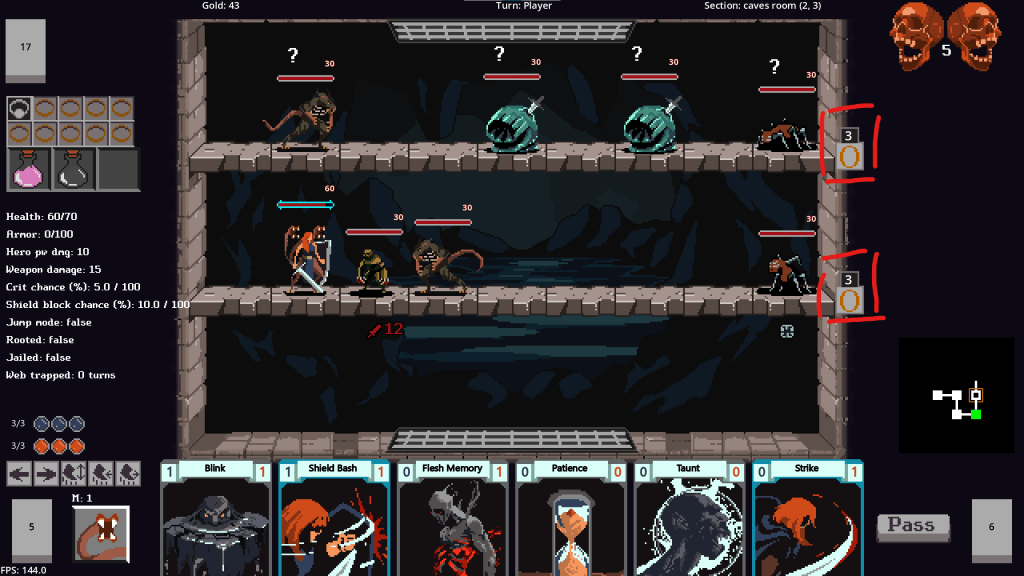
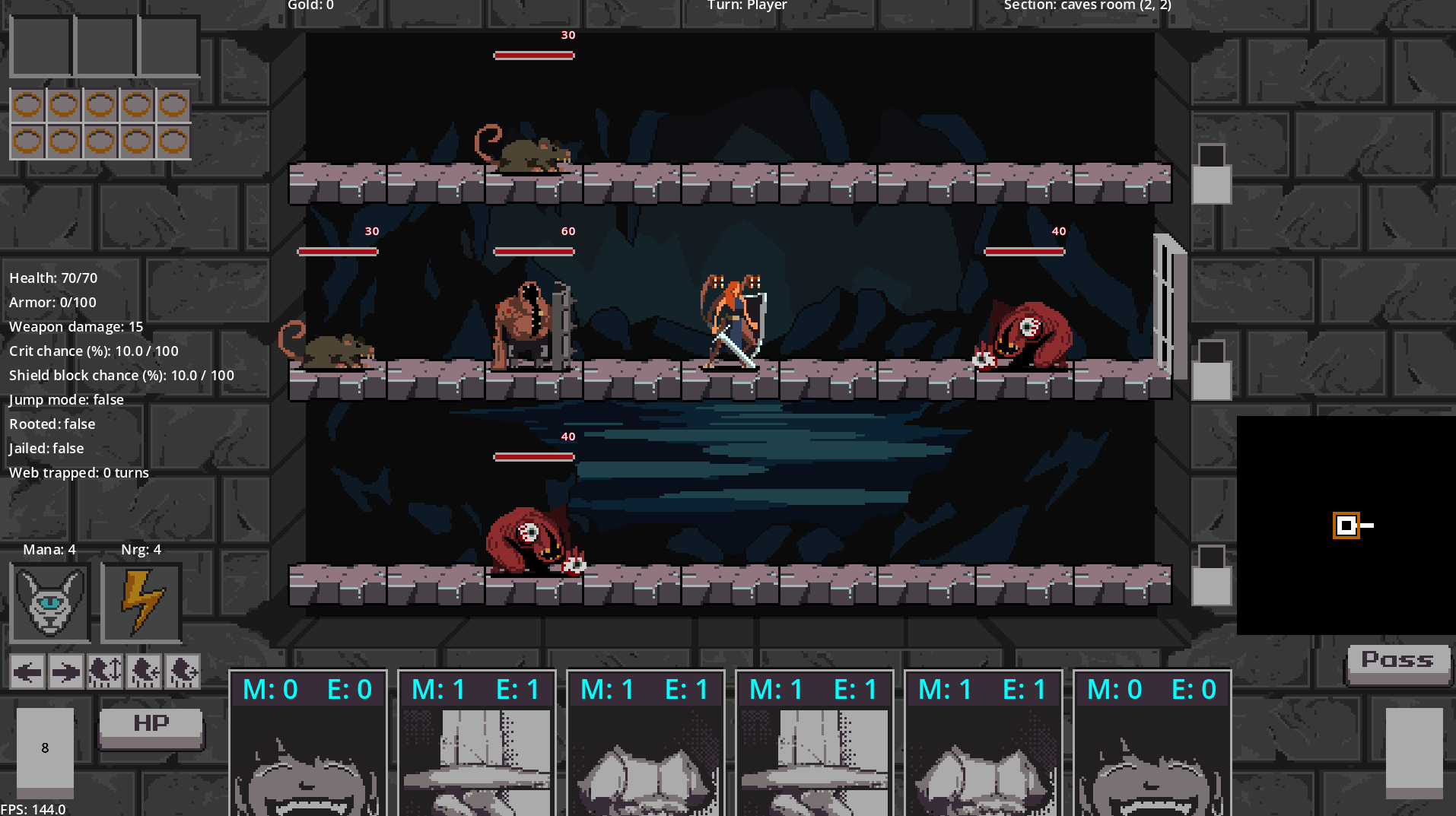
Screenshot from Gotogra. On the right you can see two lane buffs.
So what exactly is a lane buff in Gotogra?
A lane buff is a persistent effect tied to a specific lane. Once triggered, it applies powerful upgrades to all enemies currently occupying that lane. These buffs come in various forms — some grant a one-time damage immunity shield, others increase enemy damage or armor, and more exotic ones apply unique hazards. One of the most dangerous is internally referred to as “deadly traps.” While not literally lethal, this effect causes highly damaging traps to spawn on every platform within the lane when its countdown expires.
Deadly traps are particularly interesting because they only activate after the lane has been cleared of enemies. This was an intentional design decision: I wanted to discourage the player from stalling the game by cycling through their deck in a safe, empty lane. They can still do that — but only for a few turns before the lane becomes a danger zone.
This ties into player agency: the player must constantly evaluate whether to stay in a lane to benefit from a safer position or move out to deny enemies the opportunity to claim a lane buff that could tip the balance of the room. Good decision-making isn’t just about surviving the next turn — it’s about anticipating how the battlefield might evolve two or three turns ahead.
Lane buffs in Gotogra aren’t just a layer of difficulty — they’re a response to how players grow. As the player scales through cards, rings, and other upgrades, lane buffs ensure that enemies can keep up in ways that are contextual, dynamic, and fair.
I’m also toying with the idea of introducing a version of lane buffs that benefits the player. The concept would be that these buffs aren’t passive or random but come from cards the player can install during combat. It’s still early thinking — and could definitely risk creeping the game’s scope — but on paper it sounds promising. It opens up exciting design space not only for new player cards but also for new enemies that interact specifically with these player-controlled buffs.
Thanks for reading! If you’ve made it this far, I appreciate your interest and curiosity. Designing Gotogra has been a constant process of trial, error, and discovery — and systems like lane buffs are a small window into how much goes into making even simple mechanics feel meaningful.
In Gotogra, your journey begins with a single, determined protagonist — a warrior caught between survival and corruption. Early in your run, you’ll choose a weapon, and that choice doesn’t just define your combat style — it shapes your entire deck for the adventure ahead.
But we wanted to go further than just “cards in hand.” We wanted players to always have a reliable, evolving action at their fingertips — something that feels personal, something that grows with them.
This idea led to the creation of the Scourge Attack: a core ability you can trigger every turn, upgrading it over time as you ascend the cursed castle.
Design Inspirations: Hearthstone’s Hero Powers
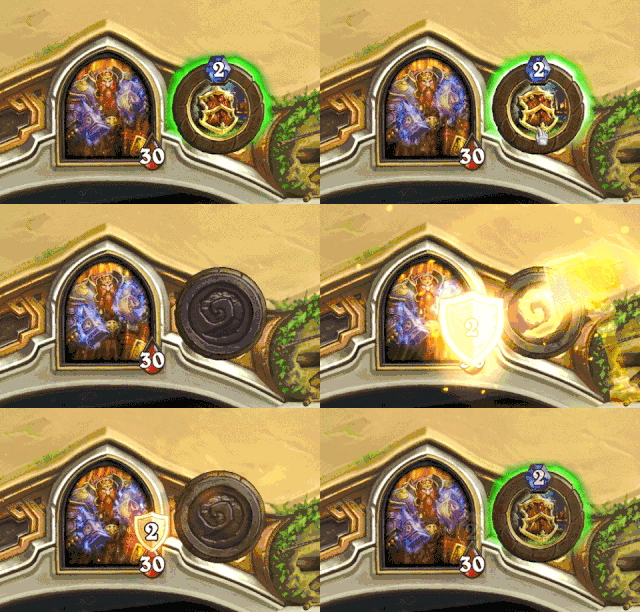
Hearthstone introduced hero powers to provide players with a consistent action each turn, ensuring they always had a strategic option, even with a suboptimal hand. Each class possesses a unique hero power, typically costing 2 mana, offering effects like dealing damage, summoning minions, or gaining armor. This mechanic was pivotal in maintaining game flow and reducing the impact of poor card draws. (source)
However, while innovative, this system has its limitations:
Static Nature: Hero powers remain unchanged throughout a match, potentially becoming less impactful as the game progresses.
Limited Synergy: They often operate independently of the evolving deck strategies, lacking deeper integration with the player’s choices.
Balance Challenges: Certain hero powers, like the Demon Hunter’s 1-mana “Demon Claws,” have sparked debates about balance due to their efficiency and synergy potential. (source)
Gotogra’s Evolution: The Scourge Attack
In designing Gotogra, we aimed to retain the accessibility of a consistent action each turn while enhancing its depth and integration with player progression. Enter the Scourge Attack:
Dynamic Progression: Unlike static hero powers, the Scourge Attack evolves during a run, influenced by player choices and upgrades.
Strategic Synergy: Its development intertwines with the deck-building process, allowing tailored strategies and combinations.
Narrative Integration: The Scourge Attack manifests the protagonist’s journey, reflecting their growth and resilience.
How the Scourge Attack Works in Gotogra
At the start of a run, the Scourge Attack is simple: a short, direct attack available every turn. It’s a reliable option when your deck is still forming and your strategy is uncertain.
As you progress deeper into the castle and make key decisions, the Scourge Attack transforms dramatically:
Extra Effects: Upgrades grant new effects like pushing enemies away, applying bleed effects, or triggering secondary combos.
Extended Reach: Enhancements can increase its range, allow splash damage across adjacent platforms, or trigger chain reactions.
Resource Modifications: Upgrades can alter its cost, making it cheaper or modifying its energy consumption for tactical flexibility.
Permanent upgrades to the Scourge Attack stem from the paths you select while ascending the castle. Every major path decision not only shapes the enemies and rewards you’ll encounter but also mutates your Scourge Attack in a meaningful way.
Additionally, supporting cards can temporarily empower your Scourge Attack for a single turn, providing extra reach, power, or secondary effects precisely when needed. This creates a layered dynamic where players can build synergies between their deck and their evolving core ability.
The result: Your Scourge Attack grows alongside your deck, staying relevant and amplifying your strategic options.
By reimagining the concept of a consistent per-turn action, Gotogra’s Scourge Attack offers players a more engaging and personalized experience, addressing some of the limitations observed in Hearthstone’s hero power system.
Stay tuned — in future blog posts, we’ll dive deeper into how different Scourge Attack mutations synergize with your deck choices and reshape the battlefield itself!
If you want to stay updated as we shape and refine Gotogra’s systems, subscribe to our newsletter and join the journey!
When designing cards for Gotogra, we follow a simple but demanding rule: every card must earn its place. In a game that blends tactical movement with deckbuilding, a card isn’t just about its effect—it’s about where, when, and how you play it.
The three pillars that guide card design in Gotogra:
1. Positioning as a Core Mechanic
Unlike traditional deckbuilders, Gotogra is built around platform-based tactical movement. Every card must account for the player’s position—and often the enemy’s as well. Some cards only work in certain directions, others affect adjacent platforms, and some require the player to have moved a certain number of tiles before being usable. Positioning turns every card into a spatial puzzle.
Positioning well is encouraged not just as a way to avoid damage, but also to deal more of it. For example, backstab attacks deal bonus damage when hitting enemies from behind. These are just two of the many advantages that stem from a strong positioning strategy.
2. Resource Costs and Tradeoffs
Cards in Gotogra are not free, and cost management is a core part of every turn. You often need to decide between spending energy to move or spending energy and/or mana to use a card. It’s no secret that the strongest cards often include built-in movement options.
Movement isn’t only important from the player’s perspective either—forcing enemies to move or predicting their movement can be just as critical. This creates a dynamic flow where every resource spent impacts both offense and defense.
3. Synergy Over Standalone Power
We avoid designing cards that “do everything on their own.” Instead, cards are built to shine when combined with others—whether that’s through hero power upgrades, relics, consumables, or clever sequencing. A card might feel underwhelming early in a run, but become the core of a powerful engine later on. The goal is to reward players who learn the mechanics and build toward their strengths.
Of course, there are also simple utility cards—ones that provide immediate value, like drawing cards, gaining a buff, or restoring health. These cards serve as flexible tools to stabilize a turn or set up a longer-term plan. They may not require intricate synergy to function, but they still play a vital role in the broader strategy.
A Practical Example: Taunt, Fear, and Whirlwind
To illustrate how positioning and synergy come together, let’s look at a specific combo that shows the tactical depth of Gotogra‘s card system:
Imagine you start your turn by playing a Taunt card. This card pulls nearby enemies toward your platform, forcing them to reposition closer to you. Next, you play two Fear cards, each causing an enemy to turn away from you—exposing their back.
Now, with enemies pulled in and turned around, you unleash a Whirlwind attack. Since you’re positioned between them and both are facing away, each strike of the Whirlwind is considered a backstab, maximizing its damage output.
What’s important here is that the movement didn’t come from the player, but from manipulating enemy movement through clever card play. This combo rewards planning, timing, and a deep understanding of how individual cards interact within the spatial rules of the game.
Another Angle: Player Movement with Teleport
Let’s now look at a combo where player movement plays a central role.
Imagine a scenario where three enemies are lined up in front of the player: a melee attacker, a mid-range enemy who can strike from behind the melee unit, and a ranged attacker at the very back. All of them are preparing to attack, and the ranged enemy is especially dangerous—he can deal high damage from the backline while staying protected by the others.
This is where the Teleport card comes in handy. Teleport instantly moves the player to the first available platform in front of them. So instead of engaging the melee enemy head-on, the player steps forward just enough to clear the path—then casts Teleport, instantly blinking past the frontline and landing right beside the vulnerable ranged enemy.
Because the ranged enemy is stuck in its attack preparation, its back is exposed—setting up the perfect opportunity for a backstab.
This interaction shows how player-driven movement can create tactical windows that feel both satisfying and skillful. It’s not just about reacting to threats—it’s about rewriting the battlefield to your advantage.
A Note on Backstabs
If this all makes backstabs sound a bit too strong—don’t worry. The scenarios shown above are carefully planned examples to demonstrate the underlying systems. In reality, Gotogra features a wide variety of enemy types, many of which are not easy to backstab at all. Some turn frequently, some cover each other, and others actively punish careless flanking. Pulling off high-damage backstabs consistently requires thoughtful planning and deep understanding of enemy behavior.
That’s all for now! If you enjoyed this look into Gotogra’s card design, consider subscribing to our mailing list—we won’t spam you, promise. And if you’d like to follow along more casually, we’d love to see you on our social channels too!
A Tactical Roguelike Deckbuilder in the Making ⚔️🃏
Gotogra is an indie game in active development that combines deckbuilding with turn-based tactical movements. Fully designed for roguelike fans who crave meaningful decisions and strategic challenges.
Hey there! I’m asnowgoose, and I’m the creator and main developer of Gotogra — a tactical roguelike deckbuilder where movement, positioning, and strategy are everything. This post marks the beginning of the official devlog for Gotogra, a space where I’ll share progress updates, thoughts on game design, and behind-the-scenes content as we build this weird, stylish little game from the ground up.
Gotogra is currently heavily in development, and our first major milestone is building a vertical slice that will be used either to pitch the game to publishers or possibly launch a crowdfunding campaign. The game already includes the core gameplay loop and several of its advanced mechanics, which we’ll explore in more detail in future posts.
This is also your chance to subscribe to our mailing list and follow along as we shape the game leading up to its release. Whether you’re here because you love roguelikes, are a game dev yourself, or just curious about what Gotogra is—you’re in the right place.
🎮 What is Gotogra?
At its core, Gotogra is a turn-based roguelike deckbuilder with a strong focus on tactical positioning.
It draws inspiration from games like Slay the Spire and Shogun Showdown, but instead of focusing solely on cards or turn-by-turn combat, it blends platform-based movement and deck management into a focused, tightly controlled experience.
Each run forces you to adapt your playstyle based on the cards, rings and consumables you find. The variety of card combinations and the evolving synergies you’ll discover—especially when paired with your hero power—ensure every run feels fresh and different.
The hero power is a mechanic inspired by Hearthstone, but with a unique twist: in Gotogra, your hero power evolves depending on the path you choose as you ascend the castle. This not only deepens strategic possibilities but also ties directly into your progression through the game’s layers. Your journey through the castle is more than just a climb—it’s a descent into mystery, as you uncover the dark truth that lies at the heart of it all. While the full details of the story will unfold inside the game itself (and trust me, it’s better experienced than explained), just know that beneath Gotogra‘s tactical shell lies a corrupted castle full of unsettling truths waiting to be uncovered.
👥 Meet the Team
Even though by industry standards I would be considered a solo dev, in reality I cannot consider myself solo in this project, I’m not doing this completely alone—and I want to give a huge shout-out to the amazing people helping shape this project:
asnowgoose — That’s me! I’m the programmer, designer, artist, and general chaos coordinator of Gotogra. I’ve gone full-time indie to make this game happen.
SORRYCAT — Composer of Gotogra’s original soundtrack and a key contributor to some of the game’s story and design systems. Expect dark, gritty, and emotional tunes that live rent-free in your head.
thelazyfactory — Our social media and marketing manager, helping us share the journey with the world. If you found us online, it’s probably thanks to her.
🧠 What to Expect From This Devlog
This devlog won’t be your typical “here’s what I did this week” kind of journal. We’ll share:
Behind-the-scenes development challenges
Sneak peeks at new art, mechanics, and systems
Thoughts on game feel, design choices, and inspirations
Playtest updates and plans for future demos
We’re also going to use this blog to build our community from the ground up—so if you’re reading this, you’re early. Like, super early. That’s a good thing. You get to watch this whole thing come together, piece by piece.
📬 Join the Mailing List
If you want first access to news, demo invitations, and cool freebies (like wallpapers, OST samples, or sneak peeks), make sure to subscribe to our mailing list below. We won’t spam you—we’re too busy making the game.
Thanks for reading this far. If you’re excited about Gotogra, a tactical roguelike deckbuilder crafted by a small indie team, we’d love it if you’d share this post or follow us on social media. This journey is just getting started, and we’re stoked to have you with us.
Follow our journey as we develop Gotogra from concept to release, and help shape an indie roguelike that blends deckbuilding, strategy, and a dark fantasy aesthetic. Join the mailing list or connect with us on social media to stay up to date!